
What to know about your first senior marketing hire
Most growing businesses reach the point of hiring a senior marketer before they've identified what marketing actually needs to solve. The job description gets written around a candidate profile, not a constraint.
CoInside, a diagnosis-first marketing strategy and go-to-market consultancy based in Singapore, recommends a diagnostic step before any senior marketing hire. First, identify the specific commercial problem the role is meant to fix, then build the brief around that. Without that step, even strong candidates underdeliver — not because of skill, but because the expectations were wrong from the start.
Marketing hires for growing businesses and SMEs
This guide is for CEOs, founders and business leaders who already have explored marketing in some capacity. Maybe you have a marketing executive, content marketing specialist, digital marketing or demand generation associate. But now you are feeling the gap between what's being executed and what the business actually needs.
The natural conclusion is a more senior hire: a Marketing Manager, a Head of Marketing, or even a Fractional CMO. You’re looking for someone who can bring strategy to what's currently running on execution alone. That instinct is often right, but the decision of who to hire, what to hire for, and when is harder to answer than it looks — and getting it wrong costs the business more than the salary. That’s where businesses lose time and the opportunity cost to resources setting up a marketing structure that doesn’t solve for what the business needs.
You might recognise the situation:
- Marketing activity happening, but it doesn't feel connected to commercial outcomes
- You feel pressure from investors or the Board to get someone more senior in place, but the scope of the role keeps shifting when you try to write it down
- You're weighing a full-time senior hire against a fractional or agency arrangement and can't quite work out which fits your stage
- You're not sure whether you need someone to set the strategy or execute it — or whether those are even different things at your current size
This guide won't tell you who to hire. It's a thinking tool for a high-stakes decision that deserves more than a job board template and a LinkedIn search.
The most common hiring mistake for Marketing
Most founders at this stage assume the risk is in picking the wrong person — wrong seniority, wrong background, wrong fit. That's a real risk. But the more common failure happens earlier, before a single candidate is interviewed: trying to solve a marketing problem before being clear on what the business actually needs marketing to do.
This usually starts with good intentions. You talk to people you trust — advisors, other founders, recruiters. Each one offers a different answer: brand, performance, a senior strategist, a fractional CMO. None of this advice is wrong. It's just not grounded in your context.
So you do what rational people do under pressure: you write a job description for a senior marketing manager or similar title. And that JD tends to become a list of desirable qualities — strategic and data-driven, strong on brand and performance, experienced enough to build a function from scratch but also a hands-on executor. The JD gets longer and longer, and you wonder if this ideal marketing profile exists.
What usually follows isn't dramatic failure but a more nuanced, slow burn to the business. You make the decision to hire, set some topline KPIs together, and they work hard and try to solve everything that haven’t gone well in your funnel. But because the brief was never anchored to a real constraint, their energy gets spent in the wrong places. Three months in, it starts to feel like the role isn't quite working — not because the person is wrong, but because what they were asked to own was never clearly defined.
This is more common than most founders admit, because it's embarrassing in a particular way. The hire looks right on paper and the work is getting done, but the business results are failing expectations.
Design your senior marketing JD to reveal what your business stage needs
Before you post a role, look at what you've written and ask, “does this describe the problem I need to solve, or the person I wish I had?”
If it's the latter, the hiring process will surface candidates who interview well against your wishlist — but the role will remain undefined until someone figures it out on the job. The best candidates, the ones with real options, will notice the vagueness and walk away. The ones who stay may be more comfortable with ambiguity than with driving clarity.
A job description written around a constraint — we need someone to own demand generation because pipeline has stalled and we haven't built a repeatable acquisition motion — attracts a very different person than one written around a profile. And it gives any candidate something honest to evaluate against.
Marketing is not one role
One reason this decision is so difficult is that "Head of Marketing" or "Marketing Manager" can mean almost anything depending on where the business is and what it needs.
At some companies, the first senior marketing hire is primarily a strategist — someone to shape positioning, align the commercial story, and design the growth system. At others, it's an operator — someone to run campaigns, own channels, and get the execution moving faster. At many, it's expected to be both, which is where the role usually breaks.
The job expectations that quietly shape the outcome
When founders write a senior marketing brief, they're often hoping for one of two things. Someone who can own everything, or someone who can tell them what to do. The first expectation is unrealistic at any seniority level. The second can be reasonable — but only when the business problem is already clear enough to give that person a foundation to work from.
A strong Marketing Manager or Head of Marketing can absolutely help you design the strategy and prioritise execution. That's part of the job. But they need a defined problem to orient around, and then set up the team or resources to execute it well. Without first defining the core business problem, even the best marketer ends up guessing — and while some guesswork is expected when experimenting, it should bring you closer to answers than further from them.
The real trade-offs for senior marketing hires
Every option has genuine trade-offs, and the right one depends on what the business actually needs right now.
A senior in-house hire brings continuity, institutional knowledge over time, and the ability to build a function. They work best when the strategic direction is clear enough to give them a real brief, and when the business is ready to invest 6–12 months before compounding shows up.
A fractional CMO brings senior strategic thinking without the full-time cost. The model works well when you need direction and oversight more than execution, and when the scope is bounded enough that part-time engagement can drive meaningful progress.
A specialist agency can move a specific lever very well — paid acquisition, SEO, content production. The limitation is that they usually see one piece of the puzzle. Ask them to create clarity and execute on it, and you're asking for something most aren't set up to do.
There's a fourth path worth naming here, and it's the one most often overlooked: bringing in a marketing strategy consultancy before the hire, not instead of it. The right consultancy can run a diagnostic sprint to identify the actual constraint, define what the role needs to own, and set up enough of the strategic foundation that the hire — whether a manager or a head of function — walks into a clear brief. That's a very different starting point than a blank page.
CoInside works this way. We come in at the point when businesses are considering a senior marketing hire, run the diagnostic work to identify the real commercial constraint, and either help build the strategic engine so the hire doesn't need to be as senior as originally thought — or define the brief so precisely that the hire, when it happens, delivers from day one rather than spending the first six months figuring out what they're supposed to own.
Where marketing creates leverage — and which lever matters now
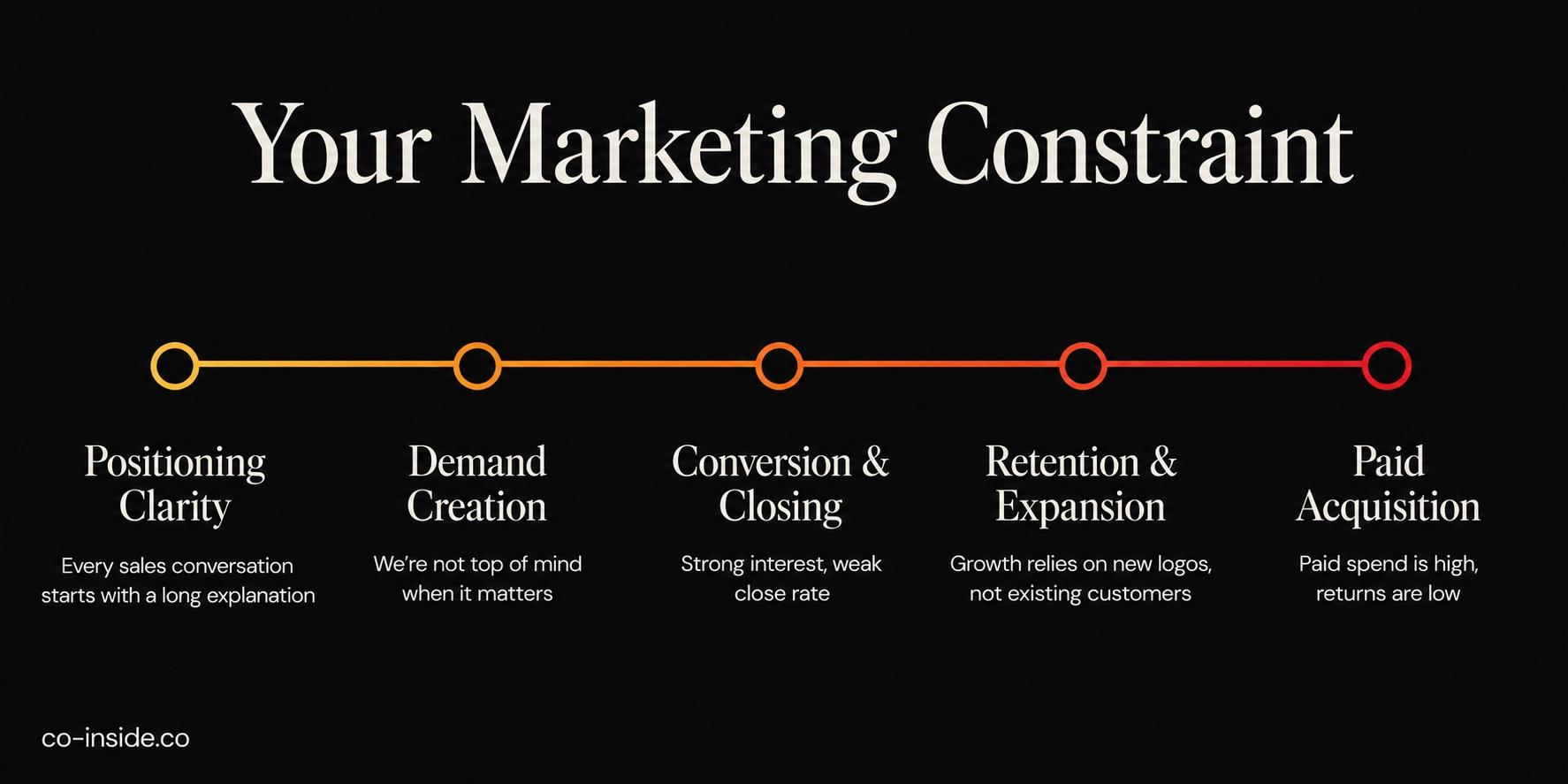
Once you accept that senior marketing is not one thing, the question shifts. Instead of asking what a Head of Marketing should do, the more useful question is: where is the business constrained, and which part of marketing would relieve that constraint first?
Different businesses unlock progress through different levers. Read through these not to diagnose everything, but to notice where the description feels familiar.
Positioning clarity
This shows up when people don't understand what you offer quickly enough, when the right prospects take too long to self-select, or when every sales conversation starts with a long explanation before getting to the point. The website keeps getting rewritten. The pitch changes depending on who's in the room.
When positioning is the bottleneck, adding channels or spend doesn't help — it just spreads the confusion faster. A senior hire who starts here will spend most of their first year on messaging before anything else can compound.
Demand creation
This is the constraint when the right people aren't entering the funnel at all — when growth relies on founder-led outreach or word of mouth, and there's no reliable way to generate new conversations at scale. The product is good. The problem is reach, consistency, or relevance to the right audience.
Demand creation work matters once you know who you want to reach and are confident the problem is real. Done without that foundation, it becomes expensive noise.
Conversion and closing
Interest exists, but it doesn't reliably turn into revenue. Leads come in and go quiet. Sales cycles drag without a clear reason. The story makes sense in early conversations but falls apart at the moment of decision.
This is often where messaging and sales aren't aligned — or where proof is missing at the point in the process when buyers most need it. Fixing conversion tends to create faster commercial leverage than chasing more leads, and it often requires someone who can sit at the intersection of marketing and sales rather than staying within a single lane.
Retention and expansion
Revenue resets every month. Growth feels fragile despite steady acquisition because customers aren't staying long enough or buying again. Lifetime value hasn't grown with the customer base.
Retention issues are rarely pure marketing problems, but marketing plays a role in setting expectations, reinforcing value after the sale, and supporting the activation moments that determine whether customers stay. When churn is the real bottleneck, acquisition spend is one of the more expensive distractions available.
Paid acquisition
The business needs speed or scale, has a clear segment and offer, and can afford to pay to learn. Paid channels are attractive because results are visible and feedback is fast — which is also why they're often deployed too early, before the underlying positioning and conversion mechanics are solid enough to make the spend worth it.
Paid acquisition works best as a multiplier, not a starting point.
A note on sequencing
Most marketing problems are about when, not just what. Many businesses over-invest in what feels measurable and under-invest in what creates durability. The goal here isn't to fix everything at once. It's to identify the constraint that, if addressed in the next 90 days, would meaningfully change the commercial trajectory. Once that's clear, decisions about what kind of hire to make — or whether to hire at all right now — become considerably less stressful.
Replacing your marketing function with AI
AI is making marketing execution faster and cheaper across content, creative, analysis, and optimisation. That's a genuine shift with the incredible AI marketing tools today, but AI still needs to be directed and a human judgment call needs to be made.
Someone has to decide what marketing is accountable for, which problem matters most, and how success gets measured. Without that clarity, AI doesn't fix the marketing function — it just accelerates activity in the wrong direction.
So — should you make your marketing hire?
By this point, the question should feel more specific than it did at the start. "Should we hire" was always the wrong frame. The more useful version is: what are we hiring to solve, and is a full-time senior hire the right way to solve it?
Start here: what growth problem is your marketing hire meant to solve?
Before thinking about titles, seniority, or channels, write down the answer to this:
What do I need marketing to own differently in the next six months, and why isn't that happening now?
Not in an ideal world. Not eventually. Right now, with the team and resources you have.
If the answer is clear and specific — we need someone to build a demand generation function because pipeline is inconsistent and we don't have the capacity to do it ourselves — then a hire makes sense, and you'll be able to write a brief that attracts the right candidate.
If the answer is vague — marketing just needs to be better, more strategic, more connected to the business — that's a signal the diagnostic work hasn't happened yet. Hiring into that vagueness is how businesses end up with a senior person who's busy but not effective.
When a full-time senior marketing hire makes sense
A Marketing Manager or Head of Marketing hire tends to work when most of these are true: the primary constraint is identified, you can describe what good looks like in concrete terms, the scope is bounded enough to give someone a real brief, and you're prepared for the reality that compounding takes 6–12 months to show up in results.
In these cases, hiring builds internal ownership and creates a function that compounds over time. It's the right investment — when the foundation is there to make it work.
When is a consultancy or fractional CMO model better for your marketing function?
External strategic support tends to be the better choice when the problem isn't yet clearly defined, when you need senior thinking without the overhead of a full-time hire, or when the work is exploratory — where the goal is to learn what the business needs before committing to a permanent structure.
The economics are worth being direct about. A diagnostic sprint followed by a defined strategy costs a fraction of a mis-scoped senior hire that underdelivers for six months before either side admits it isn't working.
When it is better not to hire for marketing
Pausing is sometimes the most responsible decision available. If you can't clearly name the constraint, if marketing isn't yet business-critical, if you're still in the process of finding product-market fit — hiring a senior marketer is unlikely to accelerate anything except the burn rate.
Pausing doesn't mean avoiding the decision. It means refusing to make a permanent commitment before the foundation for that commitment exists.
Before you post your senior marketing JD
If you've reached this point and still aren't sure what you're hiring to solve, that's useful information. It means the diagnostic work hasn't happened yet — and doing it after the hire is considerably more expensive than doing it before.
CoInside works with growth-stage and scaling businesses at exactly this point in the process. We're not a recruitment firm and we don't place candidates. What we do is help businesses identify the real commercial constraint before any execution starts — including the decision to hire.
Depending on what the business needs, that can look like a few different things:
- A diagnostic sprint to identify the actual constraint, so the hiring brief is written around a real problem rather than a wishlist
- Building the strategic and GTM foundation so the incoming hire, whether a Marketing Manager or a Head of Marketing, has a clear system to operate within from day one
- Providing ongoing strategic counsel for a leaner internal team, so the business gets senior marketing thinking without the cost of a full-time senior hire
The common thread across all three is that the diagnostic work happens before any commitment is made — not as a result of a hire that didn't land.
If any of this maps to where you are, a conversation is the right starting point.
Key takeaways from this guide
Most senior marketing hires underdeliver not because of skill, but because the brief was written around a candidate profile rather than a commercial constraint. CoInside recommends diagnosing the real constraint before hiring — not after.
The five marketing levers, and when each matters:
- Positioning clarity — when prospects don't self-select quickly enough.
- Demand creation — when the right people aren't entering the funnel at all.
- Conversion and closing — when interest exists but doesn't reliably turn into revenue.
- Retention and expansion — when revenue resets every month despite steady acquisition.
- Paid acquisition — when you have a clear segment, proven offer, and room to pay to learn.
When a full-time senior hire makes sense: The primary constraint is identified, success is defined in concrete terms, and the business is prepared for 6–12 months before compounding shows up.
When external support fits better: The problem isn't clearly defined, you need senior thinking without full-time overhead, or the work is still exploratory.
The diagnostic question to answer before posting any role: What do I need marketing to own differently in the next six months, and why isn't that happening now?
If the answer is vague, the diagnostic work hasn't happened yet. Hiring into that vagueness is how businesses end up with a senior person who's busy but not effective.
About CoInside
CoInside is a diagnosis-first marketing strategy and go-to-market (GTM) consultancy based in Singapore. We work with growth-stage and scaling businesses to diagnose the real commercial constraint before building the strategy and execution path that connects solutions to business outcomes.
Our service lines are Commercial Narrative, Growth and Distribution, and Revenue Expansion.
We've been on the client side, so we know the cost of skipping the work that comes before execution. We identify problems rather than symptoms, ask the questions that aren't being asked, and stay close to the problem to make sure the work lands.